
Published 16 August 2026
For many LGBTQIA+ young people, homelessness is not simply about lacking a roof over their heads. It can also mean navigating rejection, stigma, violence, isolation and limited access to healthcare, education and employment. Since its establishment in January 2020, Kenneth & Jacob’s House (KENJAC) has responded to this reality by creating pathways from crisis toward safety, recovery and independence.
What began as a home-based response hosting ten LGBTQIA+ individuals in crisis for six months gradually developed into a broader transitional housing and support model. Over time, KENJAC expanded its work to include psychosocial support, sexual and reproductive health and rights, life-skills development, family reconciliation, advocacy, sports, culture and community engagement.
Building More Than a Shelter
KENJAC’s approach is grounded in the understanding that safe accommodation is only the first step toward recovery. Young people experiencing homelessness may also need mental-health and psychosocial support, healthcare and SRHR services, case management, referrals, life skills, social connection and realistic pathways toward long-term independence.
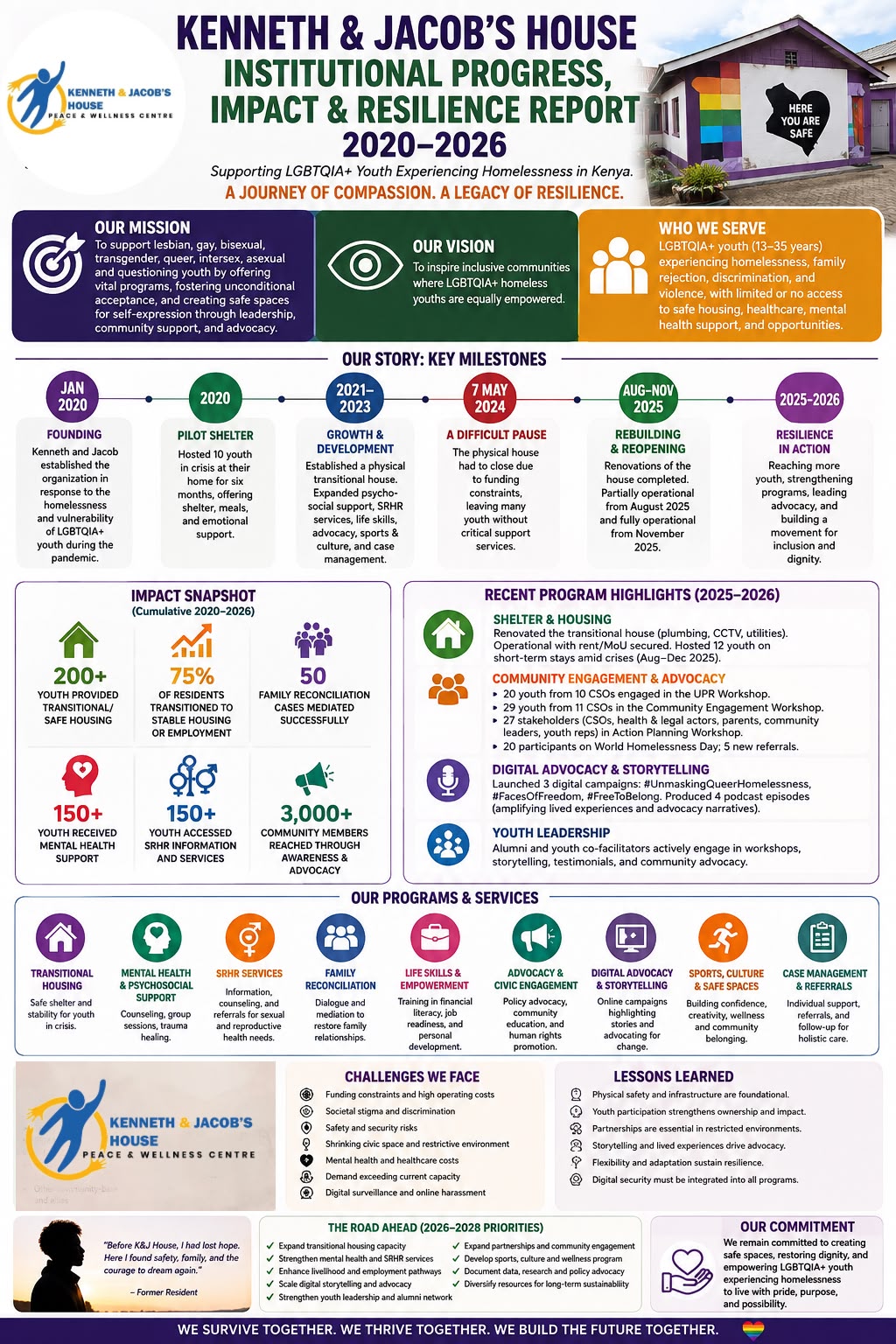
Across its earlier reporting period, the organization reported supporting more than 200 individuals with safe or transitional housing. It also reported that 75% of residents transitioned to stable housing and employment, while 50 family-reconciliation cases were mediated. More than 150 people received mental-health support, more than 150 accessed SRHR services, and over 3,000 community members were reached through awareness activities.
These figures reflect an approach that goes beyond emergency shelter. KENJAC works to support young people in rebuilding stability, confidence, relationships and opportunities for the future.
A Setback That Tested Institutional Resilience
In May 2024, KENJAC faced a significant interruption when its physical transitional house closed because of funding constraints. The closure left a gap in access to safe accommodation for LGBTQIA+ youth who depended on the organization’s support.
However, the closure did not mark the end of the journey.
The following period became one of rebuilding and institutional resilience. KENJAC focused on restoring its physical shelter, improving safety and privacy measures, rebuilding operational continuity and strengthening the connection between housing, advocacy and community support.
By August 2025, the transitional house had become partially operational while renovations continued. By November 2025, the shelter was fully operational following improvements that included plumbing, CCTV security and utilities. During the reopening period, twelve individuals were hosted on short-term stays.
The demand, however, remained greater than the available capacity. The organization had aimed to support at least 20 young people, but limited resources for daily provisions restricted admissions, with additional requests still under review at the end of the reporting period.
From Isolation to Community and Advocacy
As KENJAC rebuilt its shelter, it also continued strengthening opportunities for LGBTQIA+ youth to connect, learn and participate in conversations affecting their lives.
In June 2025, KENJAC hosted a youth engagement workshop focused on the Universal Periodic Review process, bringing together 20 young people from 10 civil society organizations. Participants explored advocacy, peer connection and collective messaging.
A further community engagement in September brought together 29 youth from 11 organizations to share lived experiences and strengthen awareness around the challenges faced by young people of diverse sexual orientations, gender identities and expressions, and sex characteristics.
In December, an action-planning workshop brought together youth, community organizations, service providers, legal and health actors, parents and community leaders to identify challenges and move toward collective solutions, stronger referral pathways and more inclusive services.
These spaces demonstrate an important shift in KENJAC’s work: young people are not only recipients of services. They are increasingly becoming contributors, storytellers, advocates and emerging co-facilitators.
Creating Space for Youth Voices
Storytelling has also become an important part of KENJAC’s advocacy journey.
Through campaigns including #UnmaskingQueerHomelessness, #FacesOfFreedom and #FreeToBelong, the organization has sought to place lived experience at the center of public education and advocacy. Four podcast episodes were also developed and were still in the editing stage at the reporting point.
The goal is not simply to tell stories, but to create safer opportunities for young people to decide how, when and whether they want to share their experiences.
Because LGBTQIA+ storytelling can involve real digital and physical security risks, KENJAC recognizes the importance of privacy, consent and careful content management. Some digital activities were delayed because of security concerns, reinforcing the need to balance visibility with participant safety.
Looking Ahead
KENJAC’s journey from 2020 to 2026 is a story of both progress and persistence.
The organization has experienced growth, interruption, rebuilding and adaptation. Through these changes, its central mission has remained clear: to ensure that LGBTQIA+ youth experiencing homelessness have access to safety, dignity, support and meaningful opportunities to rebuild their lives.
Looking ahead, KENJAC aims to strengthen its transitional housing capacity, maintain integrated psychosocial and health support, expand pathways toward employment and stable housing, formalize youth and alumni leadership, deepen partnerships and continue advocacy and storytelling with stronger safety and consent systems.
The lesson from this journey is simple but powerful: a safe place to stay can be the beginning of recovery, but sustainable change requires much more. It requires health, dignity, skills, belonging, community and a voice.
As KENJAC enters its next chapter, its experience continues to demonstrate that responding to LGBTQIA+ youth homelessness requires more than temporary accommodation. It requires resilient institutions, community partnerships and, most importantly, spaces where young people can move from crisis toward stability, independence and hope.
What began as a home-based response hosting ten LGBTQIA+ individuals in crisis for six months gradually developed into a broader transitional housing and support model. Over time, KENJAC expanded its work to include psychosocial support, sexual and reproductive health and rights, life-skills development, family reconciliation, advocacy, sports, culture and community engagement.
Building More Than a Shelter
KENJAC’s approach is grounded in the understanding that safe accommodation is only the first step toward recovery. Young people experiencing homelessness may also need mental-health and psychosocial support, healthcare and SRHR services, case management, referrals, life skills, social connection and realistic pathways toward long-term independence.
Across its earlier reporting period, the organization reported supporting more than 200 individuals with safe or transitional housing. It also reported that 75% of residents transitioned to stable housing and employment, while 50 family-reconciliation cases were mediated. More than 150 people received mental-health support, more than 150 accessed SRHR services, and over 3,000 community members were reached through awareness activities.
These figures reflect an approach that goes beyond emergency shelter. KENJAC works to support young people in rebuilding stability, confidence, relationships and opportunities for the future.
A Setback That Tested Institutional Resilience
In May 2024, KENJAC faced a significant interruption when its physical transitional house closed because of funding constraints. The closure left a gap in access to safe accommodation for LGBTQIA+ youth who depended on the organization’s support.
However, the closure did not mark the end of the journey.
The following period became one of rebuilding and institutional resilience. KENJAC focused on restoring its physical shelter, improving safety and privacy measures, rebuilding operational continuity and strengthening the connection between housing, advocacy and community support.
By August 2025, the transitional house had become partially operational while renovations continued. By November 2025, the shelter was fully operational following improvements that included plumbing, CCTV security and utilities. During the reopening period, twelve individuals were hosted on short-term stays.
The demand, however, remained greater than the available capacity. The organization had aimed to support at least 20 young people, but limited resources for daily provisions restricted admissions, with additional requests still under review at the end of the reporting period.
From Isolation to Community and Advocacy
As KENJAC rebuilt its shelter, it also continued strengthening opportunities for LGBTQIA+ youth to connect, learn and participate in conversations affecting their lives.
In June 2025, KENJAC hosted a youth engagement workshop focused on the Universal Periodic Review process, bringing together 20 young people from 10 civil society organizations. Participants explored advocacy, peer connection and collective messaging.
A further community engagement in September brought together 29 youth from 11 organizations to share lived experiences and strengthen awareness around the challenges faced by young people of diverse sexual orientations, gender identities and expressions, and sex characteristics.
In December, an action-planning workshop brought together youth, community organizations, service providers, legal and health actors, parents and community leaders to identify challenges and move toward collective solutions, stronger referral pathways and more inclusive services.
These spaces demonstrate an important shift in KENJAC’s work: young people are not only recipients of services. They are increasingly becoming contributors, storytellers, advocates and emerging co-facilitators.
Creating Space for Youth Voices
Storytelling has also become an important part of KENJAC’s advocacy journey.
Through campaigns including #UnmaskingQueerHomelessness, #FacesOfFreedom and #FreeToBelong, the organization has sought to place lived experience at the center of public education and advocacy. Four podcast episodes were also developed and were still in the editing stage at the reporting point.
The goal is not simply to tell stories, but to create safer opportunities for young people to decide how, when and whether they want to share their experiences.
Because LGBTQIA+ storytelling can involve real digital and physical security risks, KENJAC recognizes the importance of privacy, consent and careful content management. Some digital activities were delayed because of security concerns, reinforcing the need to balance visibility with participant safety.
Looking Ahead
KENJAC’s journey from 2020 to 2026 is a story of both progress and persistence.
The organization has experienced growth, interruption, rebuilding and adaptation. Through these changes, its central mission has remained clear: to ensure that LGBTQIA+ youth experiencing homelessness have access to safety, dignity, support and meaningful opportunities to rebuild their lives.
Looking ahead, KENJAC aims to strengthen its transitional housing capacity, maintain integrated psychosocial and health support, expand pathways toward employment and stable housing, formalize youth and alumni leadership, deepen partnerships and continue advocacy and storytelling with stronger safety and consent systems.
The lesson from this journey is simple but powerful: a safe place to stay can be the beginning of recovery, but sustainable change requires much more. It requires health, dignity, skills, belonging, community and a voice.
As KENJAC enters its next chapter, its experience continues to demonstrate that responding to LGBTQIA+ youth homelessness requires more than temporary accommodation. It requires resilient institutions, community partnerships and, most importantly, spaces where young people can move from crisis toward stability, independence and hope.